Goedler Will Inheritance Conditions
A Murder Is AnnouncedThe Goedler Will Inheritance Conditions set out who could receive Randall Goedler’s fortune, and when. The estate was held in trust for his wife Belle during her lifetime, then intended to pass absolutely to Letitia Blacklock; if Letitia died before Belle, the alternative beneficiaries were the legal offspring of Randall’s sister Sonia. Because Belle is gravely ill and the potential heirs are initially known only as Pip and Emma, this conditional arrangement makes survival, kinship, and concealed identity inseparable from the murder investigation.
The will’s two-stage arrangement
Randall’s fortune did not pass to Letitia immediately. He left it in trust for Belle for as long as she lived, with Letitia named to take the estate after Belle’s death. Letitia explains that Randall had made his money through ventures in which he risked much of what he earned, and that he died wealthy without children. The will therefore provided for his wife first and his faithful former secretary afterward.
The second condition concerns the order of the women’s deaths. When Inspector Craddock asks what would happen if Letitia died before Belle, Letitia says the money would go to the legal offspring of Randall’s only sister, Sonia. She recalls that Randall had quarrelled with Sonia after she married Dmitri Stamfordis, whom Randall regarded as a criminal. The alternative inheritance thus rests not simply on a family connection but on Sonia’s descendants being legally recognized as her children.
How the alternative beneficiaries entered the will
The provision for Sonia’s children was Belle’s intervention, not Randall’s original intention. Belle recalls that when Randall told her about the will, she raised the possibility that Letitia might die first. Randall had assumed Letitia was robust and Belle herself delicate, but Belle pointed out that accidents could overturn that expectation. When Randall objected to Sonia receiving his money, Belle proposed that it pass instead to Sonia’s children, Pip and Emma, or any further children she might have had. Randall grumbled but agreed to include the provision.
Belle’s account gives the clause a personal and practical history: it emerged from a conversation about an unlikely reversal of the expected order of death. She and Randall then heard nothing more of Sonia or her children. Belle allows that they might be dead or elsewhere, leaving the alternative heirs absent from the family’s life even as they remain present in the will.
The inheritance as an investigative motive
Letitia initially uses the timing of the inheritance to argue against a financial motive for Patrick and Julia Simmons. She says that if they wanted her dead for the money, it would make little sense to act when only a few weeks might remain before Belle’s death and the estate could pass to her. But Craddock identifies the crucial qualification: should Letitia die first, the money would go to Sonia’s children instead. The will therefore creates a financial stake in Letitia’s death even while the approaching end of Belle’s life makes delay consequential.
Craddock develops the clause into a line of suspicion. He imagines Sonia’s children arriving in England with little money, consulting the will at Somerset House, learning about their wealthy uncle and Letitia, and discovering that Belle is an invalid who may not live long. In that scenario, the fortune is close enough to provoke action but not yet available to the people who might claim it. Craddock consequently suspects that one or both of Pip and Emma may already be in Chipping Cleghorn under another identity. His reasoning makes the inheritance clause a mechanism that directs attention from apparent household tensions toward hidden family relationships.
The clause’s consequences and limits
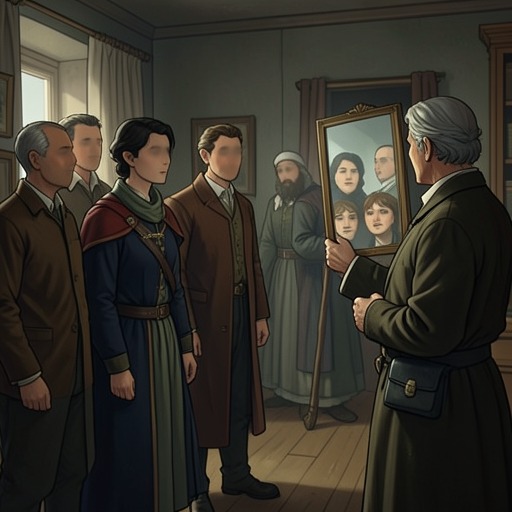
The will’s provision does not establish that either known suspect is an heir; it makes identity and legal descent questions that the investigation must resolve. When Edmund Swettenham is challenged over the possibility that he is Pip, he denies it and offers his birth certificate, schooling, and university history as proof of his identity. Phillipa Haymes then identifies herself as Pip. The scene confirms that the names under investigation conceal a real identity, while also showing that the inheritance theory cannot be settled by guesswork about age or appearance alone.
The danger surrounding the case grows as Craddock realizes the unknown murderer must devise another plan after the original scheme failed. Belle’s precarious health supplies urgency: Craddock observes that she may die at any moment, while the heirs’ entitlement depends on whether Letitia predeceases her. Later, Craddock fears that Jane Marple is already on the track and may be in danger, underscoring how the inheritance-driven investigation itself exposes those pursuing the truth to risk. The will’s terms do not dictate a single outcome, but they make the order of deaths and the proof of descent decisive to who receives the fortune.